
Let’s be real: finding beautiful furniture at CIFF 2026 is the easy part. The hard part starts when you realize you want sofas from Factory A, dining tables from Factory B, and office chairs from Factory C—but you only have enough budget (or warehouse space) for one 40HQ container.
In the industry, we call this Consolidation. In Foshan, it’s a daily occurrence, but if you don’t know the “rules of the road,” it can turn into a logistical nightmare. Here is the grounded, no-nonsense guide to mixing containers after the fair.
Why should you bother mixing a container instead of buying bulk from one supplier?
Unless you are a massive wholesaler with ten retail stores, buying a full container of a single SKU is a huge risk. You’re tied to one style, one color, and one manufacturer.
Mixing a container allows you to build a “collection.” You can test five different sofa designs or bring in a complete living room set (sofa, coffee table, TV stand) from three different specialist factories. It keeps your inventory fresh and your cash flow moving. But remember: more suppliers means more room for error.
Can you really just buy three sofas from five different factories at CIFF?
In theory, yes. In reality, it’s a struggle. During CIFF, factory sales reps are hunting for big “Volume Orders.” When you tell them you only want three pieces, their interest drops.
This is where the Foshan advantage comes in. Many of these exhibitors have showrooms in Lecong or Longjiang. If you can’t hit their “Export MOQ” at the fair, we often take our clients to their local showrooms where they are more flexible with smaller quantities. However, expect to pay a slightly higher “sample price” for those three sofas compared to a bulk price.
Where do all these different pieces go before they get on the ship?
You cannot ask five different factories to “share” a container. Factory A will not want to wait for Factory B’s truck, and none of them want to be responsible for the paperwork of others.
You need a consolidation warehouse in Foshan (usually in Longjiang or Lecong).
- Each factory delivers their goods to our warehouse.
- We sign for the goods and, most importantly, check the boxes.
- If Factory C sends the wrong color legs, it’s much easier to send it back to their factory (which is only 15 minutes away) than to deal with it when the container reaches your country.
What happens if one factory is two weeks late?
This is the most common “container killer.” You have nine factories ready to go, and the tenth factory—the one with the dining chairs—has a “production delay.”
If your container is booked for Monday, and one factory is late, you have two choices:
- Ship the container half-empty (and pay the full freight cost—terrible idea).
- Wait for the late factory (and pay “Storage Fees” and “Container Cancellation Fees”).
This is why we always set the delivery deadline for factories at least 7–10 days before the actual loading date. You need a buffer for the inevitable “Foshan delay.”
How do you handle the paperwork for 10 different suppliers?
If you try to clear customs in your home country with 10 different invoices, 10 different packing lists, and 10 different bank transfers, your customs broker will charge you a fortune, and your local customs office might flag you for an inspection.
A good sourcing agent acts as the “Exporter of Record.” We collect the 10 local invoices, pay the 10 factories in RMB, and then issue you one single Commercial Invoice and one Bill of Lading. It makes your life simple, your accounting clean, and your customs clearance much faster.
Does “mixing” increase the risk of damage during shipping?
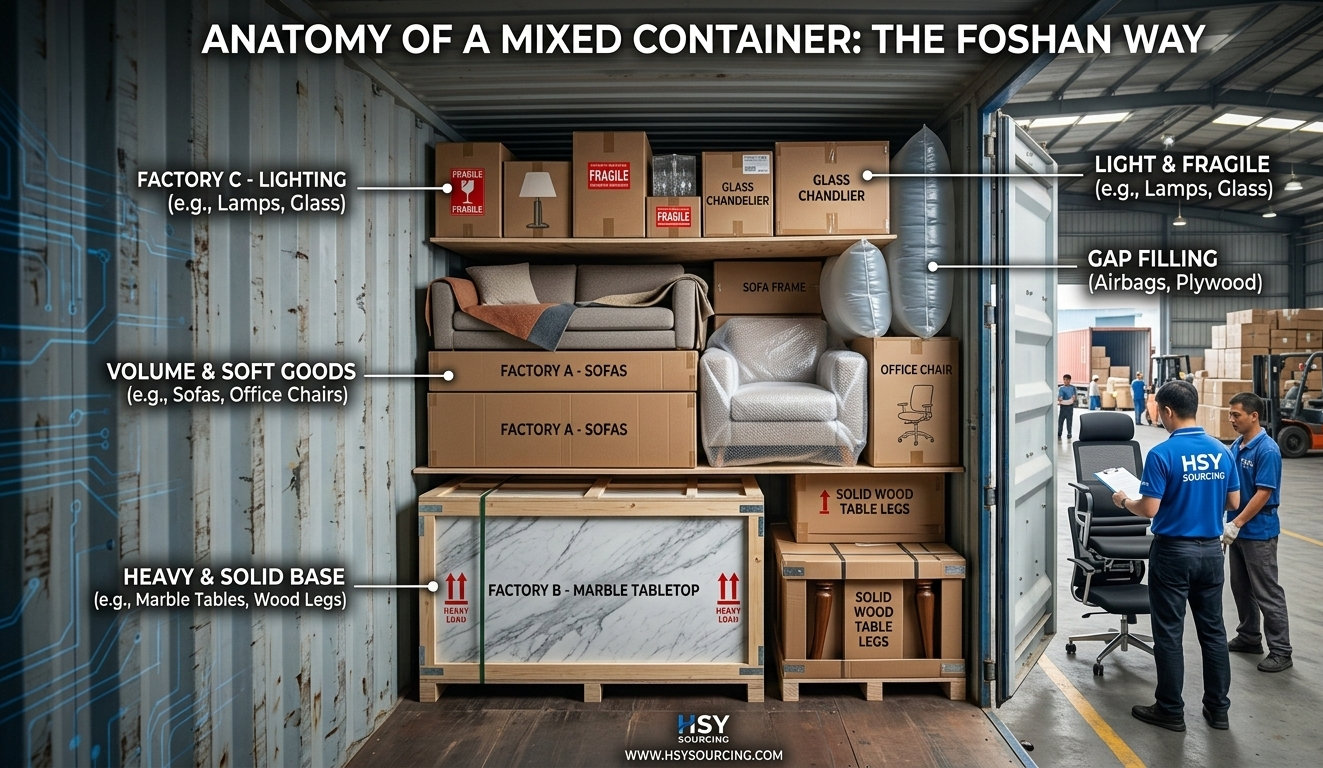
Yes, it does. If you load 50 identical boxes of the same chair, they stack perfectly. When you mix a heavy marble table, a soft velvet sofa, and a glass chandelier in one container, it’s like a game of Tetris.
The “Makers” don’t care how the container is loaded; they just want to get the stuff out of their truck. You need a supervisor on-site during loading to ensure the heavy stuff stays on the bottom and the fragile stuff stays on top. We often use extra plywood or “airbags” to fill the gaps.
The Bottom Line
Mixing containers is the smartest way for medium-sized businesses to stay competitive. It gives you the variety of a big brand without the massive inventory cost. But don’t try to do it via email from home. You need a local warehouse and a “boots on the ground” team to catch the mistakes before the doors are locked on that container.
Planning to “mix and match” after CIFF 2026? We have the warehouse space in Foshan and the experience to handle the Tetris-style loading. [Contact HSY Sourcing] to discuss your consolidation plan.
FAQ: The “Real World” of Mixing Furniture Containers
Q: Can I pay all five suppliers with one single international bank transfer?
A: If you try to pay five factories individually, you’ll lose a lot of money on bank fees and exchange rates. Most professional buyers send one large transfer to us. We then convert it to RMB and pay each factory locally. This ensures the factory starts production immediately, and you only have one set of bank paperwork to deal with. It’s cleaner, faster, and cheaper.
Q: Do you actually open every single box to check the quality in the warehouse?
A: We do a “Visual Spot Check.” If we opened every single vacuum-sealed mattress or complex dining chair, we could never pack them back into the original factory box properly. We check the outer carton for damage, verify the quantity, and open about 10% to 20% of the boxes to ensure the color, material, and finish match your order. If something looks “off,” we stop the process and call the factory boss immediately.
Q: What is the maximum number of suppliers I should have in one 40HQ container?
A: There is no “legal” limit, but our professional advice is to keep it under 8 to 10 suppliers. Why? Because every supplier adds a layer of risk. If you have 15 suppliers, the chance of one being late or sending the wrong item increases by 300%. It also makes the loading process much more difficult and increases the chance of “hidden” damage inside the container.
Q: How much does the warehouse storage actually cost?
A: Most of our clients get 7 to 10 days of free storage. This is usually enough time to collect all the items from the different Foshan factories. If one factory is extremely late and your goods sit in the warehouse for a month, there will be a small daily storage fee. This is why we are very “aggressive” with factories about meeting their deadlines—it saves you money.
Q: Who is responsible if I open the container back home and find a broken table?
A: This is the hard truth: once the container is sealed and on the ship, insurance usually only covers “total loss” (like the ship sinking). If one table is scratched, it’s usually a battle between the factory’s packing and the loading quality. This is why we take hundreds of photos during the loading process. If we can prove the factory packed it poorly, we can fight for a credit on your next order. If it was loaded well but shifted during a storm at sea, that’s just the “cost of doing business” in international trade.