
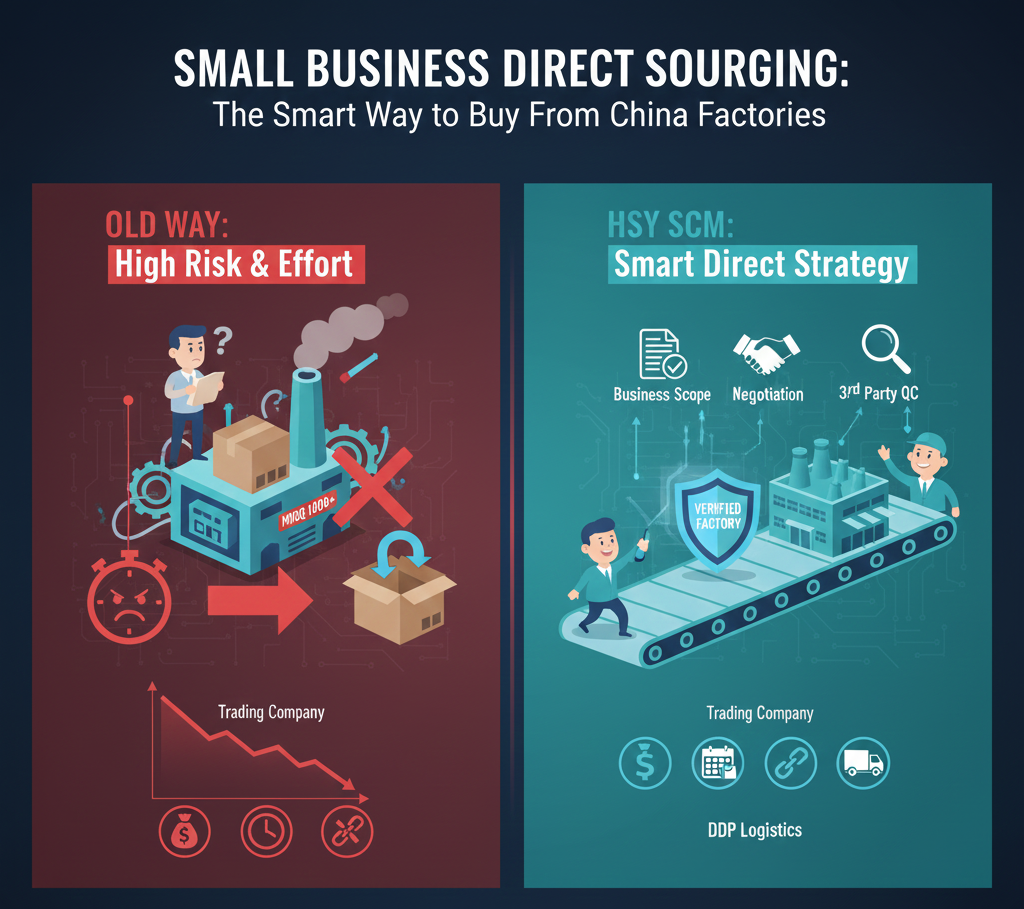
If you are a small business owner, the math seems simple: Cut out the middleman = Lower prices.
It is the most common advice in e-commerce. Why pay a trading company a 30% margin when you can go straight to the manufacturer on Alibaba?
But for small businesses, “Going Direct” is not just about finding a factory email address. It is about taking on the workload of an entire procurement department.
So, how do you secure factory-direct pricing without getting crushed by high MOQs (Minimum Order Quantities) and communication breakdowns?
It starts with knowing when to go direct and how to manage the relationship.
The Reality Check: Factory Direct vs. Sourcing Agent
Before you fire your agent, you need to understand the trade-off. You are trading Money for Time & Risk.
| Feature | Sourcing Agent / Trading Co. | Direct Factory Sourcing |
| Product Cost | Higher (includes service fee) | Lowest (Base manufacturing cost) |
| MOQ (Min. Order) | Low (50–100 units) | High (500–1,000+ units) |
| Communication | Easy (Good English, fast reply) | Hard (Technical jargon, slow reply) |
| Product Range | Broad (Can bundle multiple items) | Narrow (Only makes one niche) |
| Quality Control | Managed for you | You must hire 3rd party inspectors |
| Ideal For | Startups testing new markets | Scaling brands with proven sales |
When Should a Small Business Go Direct?
You are ready to transition from a middleman to a direct factory relationship when you hit these three milestones:
- Volume Consistency: You are ordering 500+ units per SKU regularly. Factories generally lose money on orders smaller than this.
- Product Stability: Your design is finalized. If you are still tweaking features every month, a factory will get frustrated and “ghost” you.
- Cash Flow: You can afford to pay a 30% deposit upfront and the 70% balance before the goods leave China (Risk Capital).
Importer Tip: If you are launching your first product, pay the extra margin for an agent. The mistakes you avoid will be worth more than the 20% you “save.”
How to Find a “Small-Business Friendly” Factory
Not all factories are Foxconn. You need to find a Mid-Sized Manufacturer that is hungry for growth, not a mega-factory that only serves Walmart.
1. The “Goldilocks” Factory Audit
When browsing Alibaba or Global Sources, look for these signs of a mid-sized partner:
- Registered Capital: Look for 1M to 10M RMB. (Too small = risky workshop; Too big = will ignore you).
- Response Time: If they reply within 24 hours but ask technical questions (“What is your target GSM for the fabric?”), that is a good sign.
- Niche Focus: They sell only Yoga Mats, not Yoga Mats and Bluetooth Speakers.
2. The Negotiation: “Growth Potential”
Since your volume is small, you must sell your future.
- The Pitch: “We are a U.S. brand testing this new line. Our initial order is 300 units. If the sell-through rate matches our projections, our Q4 order will be 2,000 units.”
- The Compromise: Offer to pay a “Sample Surcharge” or higher unit price for the first trial run to cover their machine setup costs.
The Hidden Risk: Quality Control (QC)
When you buy from a trader, they often check the goods for you. When you buy direct, nobody checks anything unless you pay them.
Never ship without inspection.
For small businesses, a full container audit might be too expensive. Instead, use a “Level 1” Inspection Strategy:
- Pre-Shipment Inspection (PSI): Hire a 3rd party (like Asian Sourcing Group) to check just 10% of the cartons randomly.
- Focus: Check for critical defects (does it turn on?) and packaging (barcode readability).
Logistics: The Final Hurdle
Factories are experts at making things, not shipping things.
Most factories will quote you EXW (Ex Works), meaning they leave the boxes at their back door, and you have to figure out the rest.
The Solution:
- Ask for FOB (Free on Board) pricing: The factory gets the goods to the port.
- Hire your own Freight Forwarder to handle the ocean freight and US Customs.
- Or: Ask if they have a “cooperating forwarder” who can do DDP (Delivered Duty Paid), so the price includes shipping to your door.
Conclusion
Going direct is the ultimate goal for margin optimization, but it is not a starting line.
If you have the volume and the patience, direct sourcing can double your profits. If not, a good sourcing partner is not an expense—it is insurance.
Ready to graduate from Alibaba traders to real factories?
HSY Sourcing helps small businesses bridge the gap. We audit the factory, negotiate the contract, and manage the shipping—so you get direct pricing without the direct headache.