
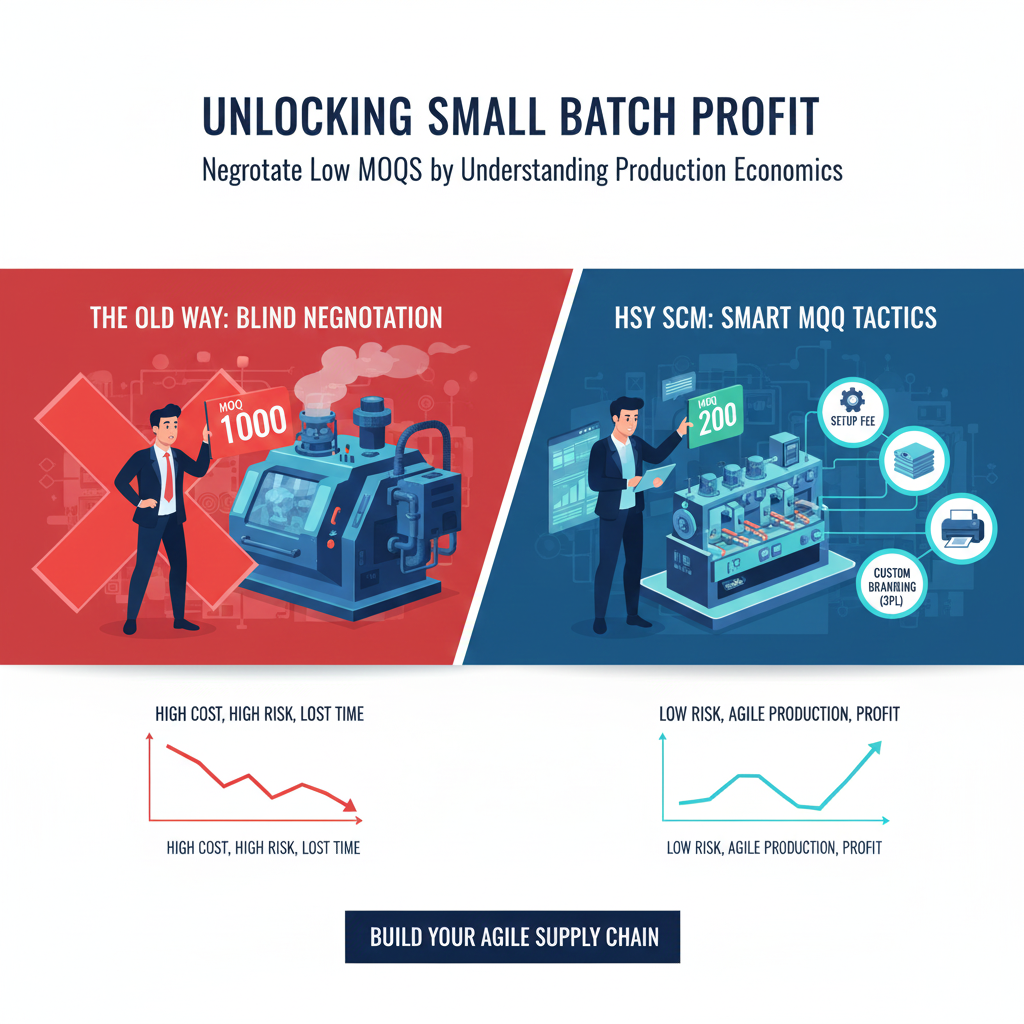
When a factory tells you their MOQ is 1,000 units, they aren’t pulling a number out of thin air. They are calculating Machine Setup Time, Material Scrappage, and Labor Opportunity Cost. If they run your 100-unit order, they might actually lose money.
To negotiate a lower MOQ, you shouldn’t ask for a favor. You should offer a solution that makes the small run viable for their production manager. Here is the professional playbook.
1. Solve the “Setup Cost” Problem
The biggest hurdle for a factory is the time it takes to calibrate machines for a specific design. If it takes 3 hours to set up a machine for a 2-hour production run, the factory loses.
The Tactic: Pay the “Setup Fee” Directly.
Instead of asking for a lower price, offer to pay a flat $200–$500 “Sampling/Setup Fee” that is refundable once your cumulative orders reach 5,000 units.
- Why it works: It de-risks the order for the factory. They get paid for their labor even if you never order again.
2. Leverage “Stocked Raw Materials”
Factories hate buying small quantities of raw materials (like fabric or specific plastic resins) because their suppliers have MOQs too.
The Tactic: Sync Your Product with Their Current Production.
Ask the factory: “What materials do you currently have in stock for other clients?”
- The Play: If they are already running 10,000 blue yoga mats for another brand, they can easily add 200 of your mats to the end of that run using the same material.
- The Result: You get a low MOQ because you aren’t forcing them to source new, small-batch raw materials.
3. The “Sequential” MOQ Strategy
Many factories have a high MOQ for the final product but a lower MOQ for the components.
The Tactic: Commit to the Material, Not the Finished Unit.
Offer to pay for the raw materials for 1,000 units upfront, but only have them assemble and “finish” 200 units at a time.
- Why it works: The factory locks in the material sale, and you save on warehouse storage and cash flow by only taking finished stock as needed.
4. Use “Ready Goods” (Neutral Stock)
In hubs like Shenzhen or Guangzhou, many factories keep “Ready Goods”—products that are already manufactured but unbranded.
The Tactic: Source the Product and the Branding Separately.
Instead of asking for a custom-molded product at low volume, buy 100 units of “Neutral Stock.”
- The Customization: Use a third-party service (like HSY SCM) to handle the laser engraving or custom packaging in a separate facility. This allows you to bypass the factory’s rigid production MOQ entirely.
5. Speak the Language of “Future Scalability” (With Data)
Factories are looking for “High Potential” partners. If you just say, “We will order more later,” they won’t believe you.
The Tactic: Provide a Sourcing Roadmap.
Show them your marketing plan, your current Amazon rankings (if applicable), or your distribution network.
- The Offer: “We are launching 3 products this year. We need a partner who can handle 200-unit ‘Market Tests’ so we can quickly identify which one to scale to 10,000 units.”
- The Result: You become a strategic partner, not just a “small customer.”
Comparison: The Wrong Way vs. The Pro Way
| The Amateur Approach | The Professional Approach (HSY SCM Style) |
| “Can you do 100 units?” | “What is the setup cost for a 100-unit trial run?” |
| “The price is too high for small orders.” | “I understand the material waste; can we use stocked fabric?” |
| “I’ll order more if it sells.” | “Here is our 12-month growth roadmap for this SKU.” |
| Asking for custom colors immediately. | Starting with a “Neutral” color to utilize existing material runs. |
It’s Not About Price, It’s About Profitability
A factory will say “Yes” to a small order if you make it profitable for them. By paying setup fees, using stocked materials, or managing your own branding, you remove the friction that causes them to say “No.”
At HSY SCM, we specialize in these “soft negotiations.” We know which factories are currently running specific materials and how to slot your small order into their existing schedule.