
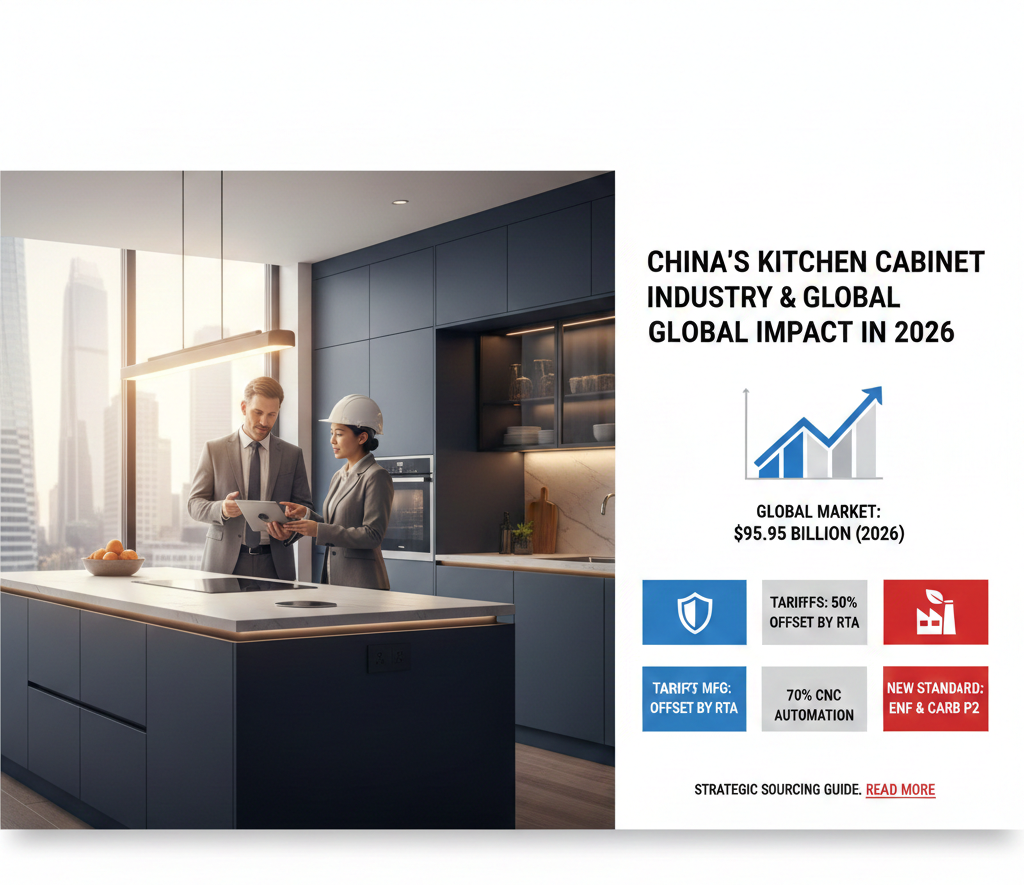
As we move into 2026, the landscape of China’s kitchen cabinet industry has shifted from a “low-cost workshop” to a “smart manufacturing powerhouse.” With the global kitchen cabinet market projected to hit USD 95.95 billion this year, China remains the epicenter, supplying approximately 39% of the world’s cabinetry.
However, for international buyers, 2026 brings new complexities—from 50% tariffs in specific markets to the rise of AI-integrated smart cabinets. This guide uses a Q&A format to address the most pressing, real-world questions we receive from professional developers and wholesalers today.
Q1: With the 2026 tariff hikes (especially in the US), is sourcing from China still financially viable?
The Reality: As of January 1, 2026, many wood products face increased scrutiny and higher duties. However, the “China Price” advantage isn’t just about labor anymore; it’s about supply chain density.
- The Data: Google Trends shows a 40% spike in searches for “RTA (Ready-to-Assemble) cabinets” and “flat-pack kitchens.” Why? Because shipping air is expensive.
- The Solution: We are helping clients pivot to Semi-Custom RTA models. By optimizing the packing density, we often reduce freight costs by 30%, which offsets a significant portion of the tariff impact. Additionally, for large-scale projects, sourcing “frameless” European-style cabinets from China remains 20-25% cheaper than domestic production in North America or Europe, even after duties.
Q2: How do I distinguish between a “Top 10” brand and a “Project-Specific” factory in Foshan?
The Reality: Buyers often chase big names like Oppein or GoldenHome. While they are excellent, their overheads are high and MOQs (Minimum Order Quantities) are strict.
- Sourcing Insight: * Tier 1 (The Giants): Best for retail showrooms needing a famous brand.
- Tier 2 (The Hidden Champions): Located mainly in Foshan (Shunde) and Dongguan. These factories use the same German HOMAG machinery but are much more flexible with custom finishes and “non-standard” sizes for apartment projects.
- Pro Tip: Don’t just ask for a catalog. Ask: “What percentage of your production is CNC-automated?” In 2026, if a factory isn’t at least 70% automated, your risk of “size deviation” in a 500-unit project is too high.
Q3: What are the “Red Flags” in material quality that I should look for in 2026?
The Reality: With the global push for sustainability, “E1” grade is no longer enough. In 2026, ENF (Zero-Formaldehyde) and CARB P2 are the baseline.
- The Trap: Some suppliers claim “Solid Wood” but use low-density particle board for the carcass to save costs.
- Our Solution: We conduct Cross-Section Inspections. We don’t just look at the door panel; we drill into the carcass of a random unit to verify the core density.
- 2026 Trend: We see a massive shift toward PET-coated panels and anti-fingerprint laminates. They are more durable than traditional lacquer and much faster to produce.
Q4: How do I handle the “Hardware Mystery”? (Blum vs. Local Brands)
The Reality: Hardware is where 80% of after-sales complaints happen.
- The Solution: In 2026, unless the budget is extremely tight, we always recommend DTC (top-tier Chinese brand) or Blum/Hettich.
- The Risk: Many factories use “Look-alike Blum” hinges. Our QC process includes a Magnet Test and a Batch Weight Check—counterfeit hardware is almost always lighter and uses inferior alloys that rust within 12 months in humid climates.
Q5: Can Chinese factories handle “Smart Kitchen” integrations for 2026 projects?
The Reality: Yes, and they are leading the way. The NKBA 2026 Trends Report highlights a 66% increase in demand for integrated lighting and smart storage.
- Current Capability: Leading Foshan factories now offer “Plug-and-Play” cabinetry with:
- Pre-milled LED channels (UL/CE certified).
- Voice-activated pantry pull-outs.
- Embedded wireless charging stations in islands.
- The Challenge: The bottleneck is usually Electrical Certification. We ensure that all integrated electronics meet your country’s specific safety standards before the containers are sealed.
Summary: The 2026 Sourcing Checklist
| Focus Area | What to Verify | Why it Matters |
| Machinery | Is it German HOMAG or Italian Biesse? | Ensures precision to within 0.5mm. |
| Material | Is it ENF or CARB P2 certified? | Avoids customs seizures and health lawsuits. |
| Lead Time | Is it 35 days or 60 days? | Crucial for project scheduling and cash flow. |
| Hardware | Is it genuine DTC or Blum? | Prevents 90% of future maintenance issues. |
How We Help You Navigate 2026
Sourcing from China in 2026 is no longer about finding the cheapest price—it’s about managing risk, compliance, and logistics.
Whether you are a developer looking for 200 sets of kitchen cabinets for a multi-family project or a wholesaler seeking the latest PET-finish trends, we provide on-the-ground inspection, factory auditing, and consolidated shipping.