
Most e-commerce sellers are an open book. If you source a finished product from a single factory in China, you have no “moat.” A competitor with basic detective skills (or a paid import database) can find your supplier, copy your listing, and underprice you within weeks.
The brands that actually scale to 7 and 8 figures don’t play that game. They use what we call a “Ghost Supply Chain.”
They don’t have a supplier. They have a network. At HSY SCM, we sit at the center of these invisible networks. Here is how the big players hide their tracks and protect their margins.
1. Stop Buying “Finished Goods”
The biggest mistake is the “One-Stop-Shop” trap. When you ask a factory to handle everything—sourcing the raw materials, the electronics, the packaging, and the assembly—they own you. They know your entire “recipe.” If your product starts selling well, nothing stops that factory from selling your design “out the back door” to other buyers.
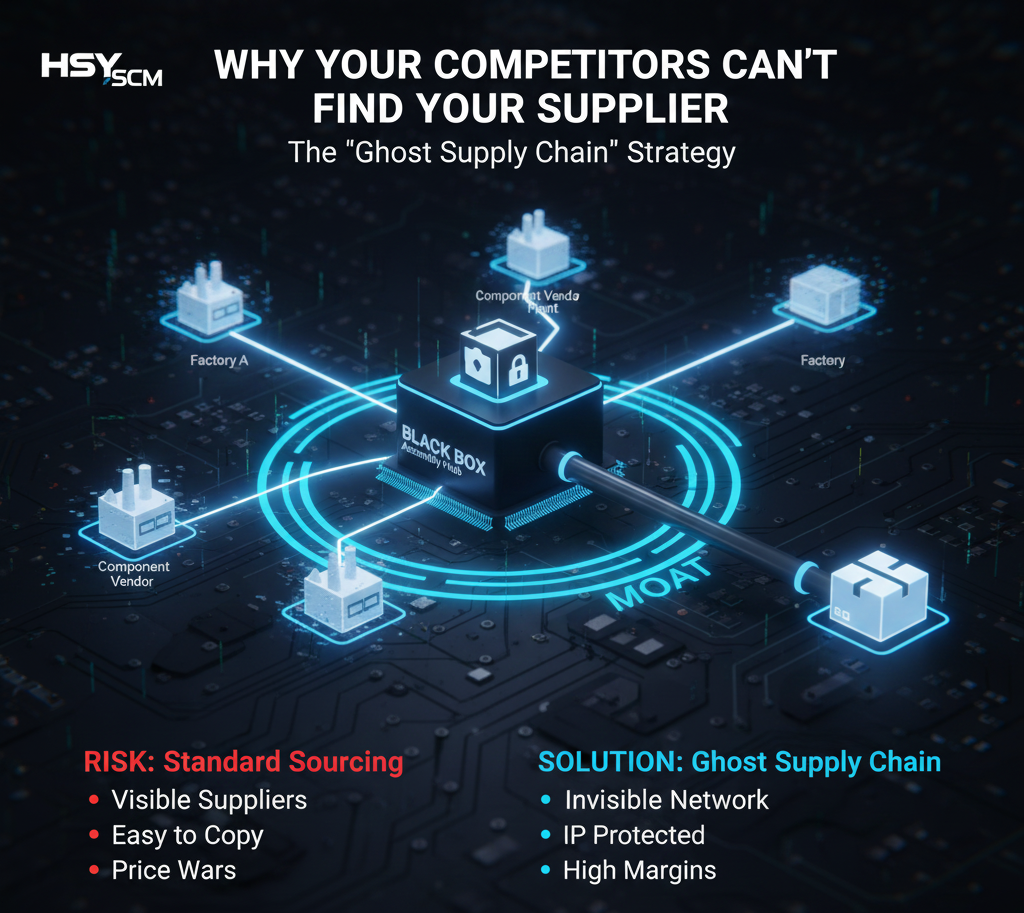
The Secret Strategy: Fragmented Sourcing. You source the core components from three different factories that don’t talk to each other.
- Factory A makes the metal housing.
- Factory B makes the PCB (the electronics).
- Factory C makes the custom luxury packaging.
None of these factories know what the final product looks like.
2. The Neutral Hub: The “Black Box” of Your Brand
In a Ghost Supply Chain, the most important player isn’t a factory; it’s the Assembly Hub. This is where HSY SCM comes in.
We act as the “Black Box.” All those fragmented parts from Factories A, B, and C arrive at our warehouse. Our team does the final assembly, the quality control, and the kitting.
Why this is a game-changer:
- Supplier Anonymity: Factory A thinks they are just making metal parts for a generic client. They have no idea you’re building a high-end coffee machine.
- Import Record Chaos: When competitors look at your shipping data, they only see “HSY SCM” or a neutral logistics entity as the shipper. Your actual manufacturing sources stay invisible.
3. “Neutralizing” Your Components
If you want to be truly uncopyable, you need to use Neutral Components for the parts that are easy to find.
Don’t ask a factory to customize a standard screw or a generic cable. Use off-the-shelf, standard parts for the “guts” of the product and save your customization budget for the “Signature Component”—the one part that defines your brand.
By keeping the signature component’s production separate from the main assembly, you ensure that even if a factory worker leaks a design, they only have a piece of the puzzle, never the whole picture.
The “Ghost” Workflow: A Comparison
| Feature | Standard Sourcing (The “Easy” Way) | Ghost Supply Chain (The “Elite” Way) |
| Visibility | Competitors find your factory in 5 mins. | Suppliers are hidden behind a neutral hub. |
| IP Protection | The factory can “back-door” your product. | No single factory has the full design. |
| Pricing Power | You pay the factory’s “convenience” markup. | You negotiate raw component prices directly. |
| Business Value | You own a brand. | You own a proprietary system. |
How to Start Your Ghost Supply Chain
You don’t need a massive team to do this; you just need a partner on the ground who knows how to manage the pieces.
- Audit Your BOM: Look at your product’s Bill of Materials. Which part is the “secret sauce”? Which parts are generic?
- Separate the Signature: Move the production of your secret sauce to a specialized vendor.
- Control the Hub: Ship everything to HSY SCM. We become your private assembly line. We don’t sell products; we protect yours.
Conclusion: Privacy is Profit
In e-commerce, being “easy to find” is a liability. A Ghost Supply Chain is the ultimate insurance policy for your brand. It’s harder to set up than a simple Alibaba order, but it’s the only way to build a brand that stays on top for years instead of months.