
In the world of Amazon FBA and Shopify, most “brands” are just a logo slapped on a generic factory product. This isn’t a business; it’s a countdown. If a competitor can find your supplier on a public database like ImportYeti or 1688, they can clone your entire business in 30 days.
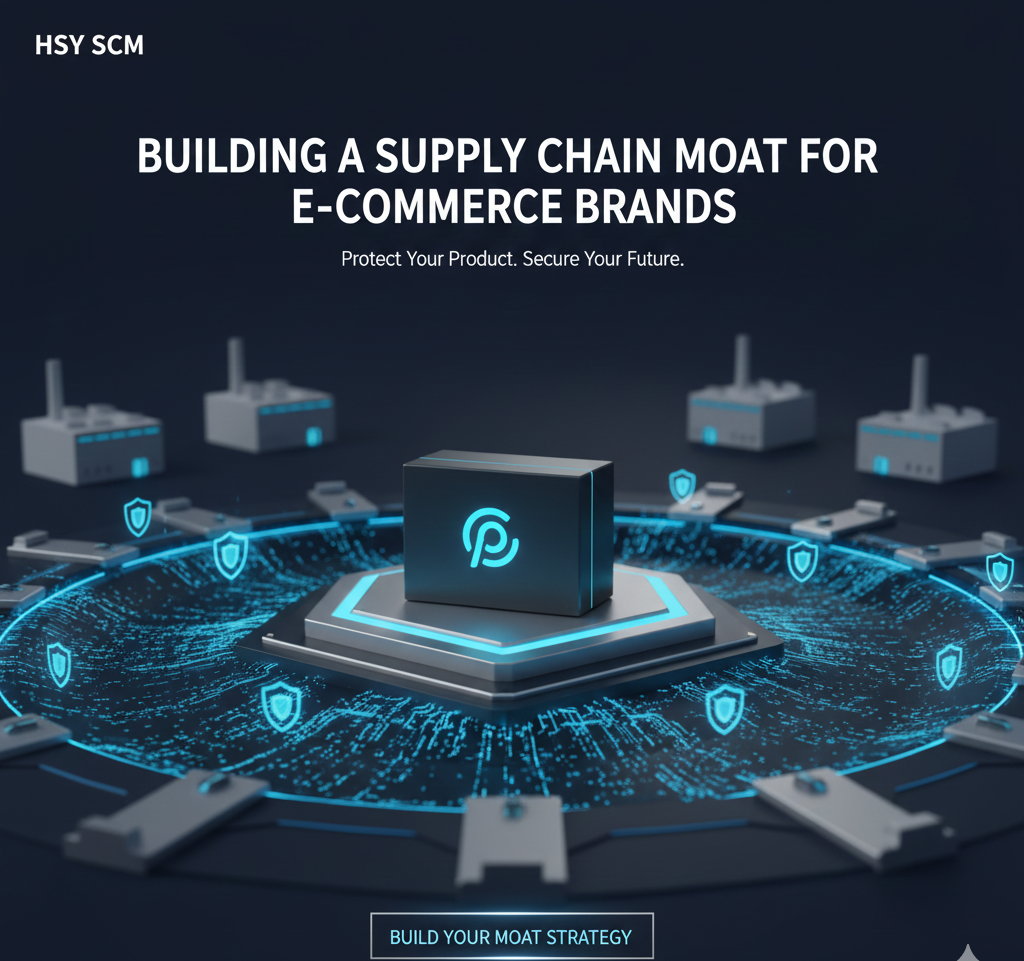
To survive, you need a Supply Chain Moat.
A moat is a structural advantage that makes you harder to copy, more expensive to compete with, and significantly more valuable when it comes time to sell your brand. At HSY SCM, we don’t just find suppliers; we build these moats.
The 3 Levels of Supply Chain Defense
Level 1: The “Public” Strategy (Zero Defense)
You buy a finished product from a single factory. You are listed as the consignee on the Bill of Lading.
- The Risk: Total. Your factory knows your sales volume and can sell your “seconds” to competitors. Competitors can track your shipments to the exact factory gate.
Level 2: The “Ghost” Strategy (Moderate Defense)
You use a Sourcing Agent to act as the “Shipper” of record.
- The Moat: Your import records show a neutral entity (like HSY SCM) instead of the factory name. This buys you time, but a smart competitor can still reverse-engineer your product.
Level 3: The “Fragmented” Strategy (Maximum Defense)
You break your product down into a Bill of Materials (BOM) and source from multiple, unrelated vendors.
- The Moat: No single factory sees the final product.
- Factory A makes the electronics.
- Factory B makes the custom housing.
- HSY SCM performs the final assembly and kitting in our own warehouse.
- The Result: You own a “proprietary system” rather than a “product.” This is a true moat.
Why a Moat Increases Your Brand Valuation
When an aggregator (like Thrasio or Perplexity) looks to buy a brand, they look at defensibility.
- Supply Chain Secrets: If you can prove that your product cannot be replicated by simply calling one factory, your “multiple” (the price they pay for your business) goes up.
- Cost Control: By sourcing components separately, you bypass the “convenience markup” a single factory charges to manage sub-suppliers for you.
- IP Protection: When you control the final assembly at a neutral hub, your Intellectual Property (IP) is physically secured. The factory that makes your mold doesn’t have the electronics to make the product work.
How We Build Your Moat at HSY SCM
Building a moat sounds complicated, but it’s just a workflow change.
- Deconstruct the Product: We help you identify which 20% of your product is “proprietary” and which 80% is “commodity.”
- Diversified Sourcing: We place orders with different specialist factories. We keep them “siloed”—they don’t need to know who the other suppliers are.
- The Neutral Hub: All parts arrive at our facility. We perform a “Blind QC”—checking parts against your specs without the factory knowing the final application.
- Kitting & Final Mile: We bundle the components, add your custom packaging, and ship under a neutral BOL.
Stop Being an Easy Target
A supply chain moat isn’t just about “hiding.” It’s about ownership. When you own the assembly and the component relationships, you own the brand. Everything else is just reselling.
Is your supply chain an open book for your competitors? Let’s talk about how to close it.