
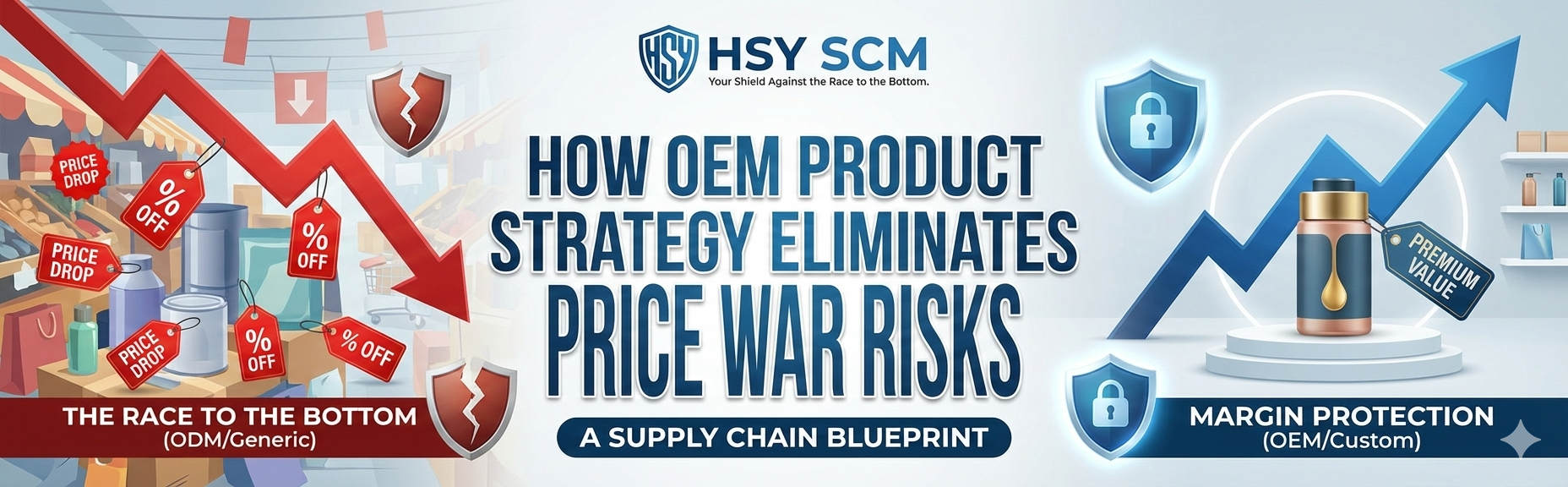
In modern e-commerce, the “Race to the Bottom” is a silent brand killer. When you source a Private Label (ODM) product that is identical to your competitors’, your only lever for growth is price. Eventually, your margins vanish, and your business becomes unsustainable.
The only way to escape this cycle is to move from commodity to exclusivity.
By adopting an OEM (Original Equipment Manufacturing) strategy, you stop competing on price and start competing on value. At HSY SCM, we specialize in helping brands transition from generic sourcing to custom manufacturing. Here is how an OEM strategy protects your bottom line.
The Economics of the Price War
A price war occurs when products are fungible—meaning the customer sees no difference between your item and the next.
- Private Label (ODM) Risk: You find a product on Alibaba. 500 other sellers find the same product. The customer chooses the cheapest one. You are forced to lower prices to stay in the “Buy Box.”
- OEM (Custom) Opportunity: You identify a flaw in the market’s current offerings and work with a factory to create a unique version. Because no one else has your specific product, there is no “direct” price comparison.
3 Ways OEM Strategy Protects Your Margins
1. The “Feature Gap” Advantage
Price wars happen when features are identical. OEM allows you to “re-engineer” the product based on customer pain points.
- Action: If competitors’ products have a 20% failure rate on a specific hinge, your OEM strategy involves designing a reinforced steel hinge.
- Result: You can charge 15% more because you solve a problem the cheaper versions cannot.
2. Intellectual Property (IP) as a Shield
With Private Label, you have no legal grounds to stop others from selling the same item. With OEM, you own the Design Patent and the molds.
- Action: Work with HSY SCM to secure exclusive manufacturing agreements and register your design rights.
- Result: You can legally remove “copycat” listings on Amazon and other platforms, effectively eliminating your competition.
3. “Bundle-Proof” Sourcing
Price wars are hardest on single-item listings. OEM allows you to create custom “kits” or “bundles” that are physically impossible for others to replicate without your specific components.
- Action: Use HSY SCM’s owned warehouse to consolidate custom-made accessories from different factories into a unique brand set.
- Result: You create a unique SKU with a perceived value far higher than the sum of its parts.
Comparing the Strategies: Risk vs. Reward
| Metric | Private Label (ODM) | OEM Product Strategy |
| Price Control | Market-driven (Low) | Brand-driven (High) |
| Moat/Defensibility | None (Anyone can buy it) | High (You own the tools/IP) |
| Customer Loyalty | Low (Price-sensitive) | High (Solution-sensitive) |
| Margin Stability | Volatile | Stable & Protected |
Step-by-Step: Moving from Price War to Product Leader
How do you transition without risking your entire capital?
- Analyze the “Hate”: Read the 1-star and 2-star reviews of your competitors’ Private Label products.
- Prototype the Fix: Work with the HSY SCM Product Development team to create a technical drawing that fixes those issues.
- Invest in Tooling: Pay the upfront mold fee. In e-commerce, a $3,000 mold fee is often the cheapest “insurance policy” against a million-dollar price war.
- Control the Hub: Ship your unique components to our China warehouse. We ensure that no one—not even the factory—can sell your completed “kit” to anyone else.
Exclusivity is the Ultimate Margin Protection
You cannot win a price war against a factory or a seller with lower overhead. You win by changing the game.
An OEM product strategy isn’t just about making something “new”; it’s about making something unbeatable. By investing in your own designs and a secure, transparent supply chain with HSY SCM, you build a brand that customers choose for its quality, not its discount.