
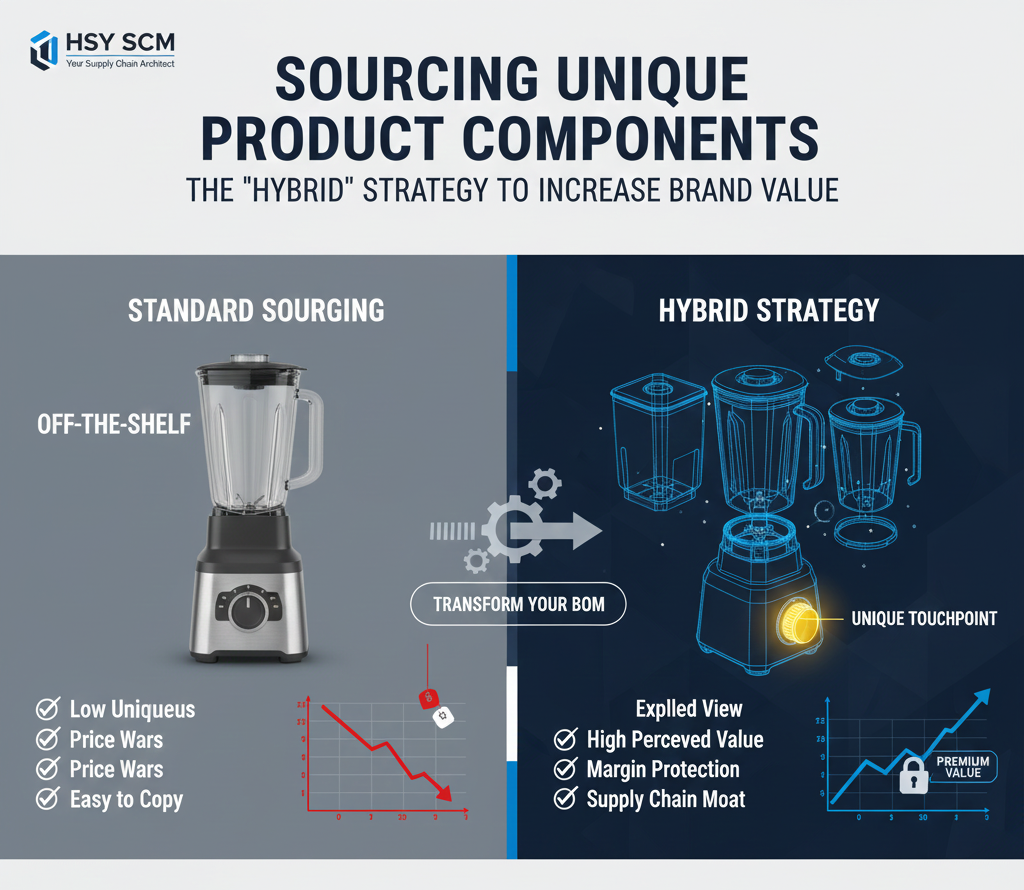
In today’s e-commerce landscape, sourcing a finished product from a factory catalog and slapping your logo on it is a suicide mission. If you’re selling the exact same “public mold” product as 500 other sellers, your only weapon is price. And in a race to the bottom, everyone loses.
But fully designing a product from scratch (Full OEM) is expensive—tooling fees alone can eat up your entire launch budget.
There is a smarter middle ground: Component-Level Sourcing (The Hybrid Strategy). The goal? Keep the “guts” standard to save money, but customize the “touchpoints” to build value. Here is the insider’s blueprint on how to do it.
What is “Hybrid Sourcing”?
Instead of buying a finished unit, you break the product down into its Bill of Materials (BOM).
Take a standard stainless steel garlic press. Everyone sells the same one. But what if you source the metal crusher (the cheap, heavy part) from a high-volume factory, but then source a custom-designed, ergonomic walnut handle from a boutique woodshop?
Your cost might go up by $1.00, but your retail price can jump by $15.00 because it no longer looks like a commodity.
Why the Pros Use This Strategy
1. Own the “Touchpoints”
Customers judge quality based on what they actually feel.
- The Play: Identify the parts of the product the user interacts with most—handles, buttons, fabric, or zippers.
- The Move: Keep the internal electronics or frame “standard” (to save on R&D), but upgrade the “touchpoints” to premium materials. This creates a high-end perception for the entire product.
2. Hide Your Supply Chain
If you buy a finished product, a competitor can find your supplier on Alibaba in ten minutes.
- The Play: Fragment your production. Factory A makes the core; Factory B makes the custom accessory.
- The Move: Ship both to our HSY SCM consolidation warehouse. We handle the assembly and kitting.
- The Result: You’ve built a “supply chain moat.” Your competitors can’t find your “supplier” because your supplier is actually a network that only you control.
3. Zero-Risk Innovation
Opening a full set of molds for a new OEM product takes 4 months and thousands of dollars.
- The Play: Keep the core product the same, but swap out the accessories.
- The Move: If you sell a yoga mat, keep the mat standard but source five different unique carry-strap designs. Test which one sells at a premium. It’s the fastest way to find a winner without risking massive capital.
Case Study: The “Premium” Chef’s Knife
The Commodity Path: Buy a standard knife with a plastic handle. Retail: $25 (and you’re fighting for every cent).
The Hybrid Path:
- The Blade: Source from a massive factory (utilizing their economy of scale).
- The Handle: Source a custom G10 resin handle with a unique color pattern.
- The Packaging: A custom magnetic gift box.
- The HSY Factor: We assemble the handle to the blade, perform QC, and box it in our warehouse.
The Result: A unique brand asset that retails for $65.
How HSY SCM Makes This Easy
Managing three factories for one product is a logistical headache. We act as your “Control Tower.”
- BOM Strategy: We help you identify which component will give you the highest ROI for customization.
- Specialized Sourcing: We find the right factory for the core and a different specialist for the custom part.
- Assembly & Kitting: We receive all parts at our China facility, assemble them, and ensure the “fit and finish” is perfect.
- IP Protection: Because we handle the final assembly, no single factory knows your entire product secret.
The Bottom Line: Defensibility is Profit
To build a brand worth selling, you have to stop being a reseller and start being a product developer. You don’t need to reinvent the wheel; you just need to source a better “spoke.”
Stop fighting over pennies on generic goods. Let’s look at your product together and find the one component that will 2X your brand value.